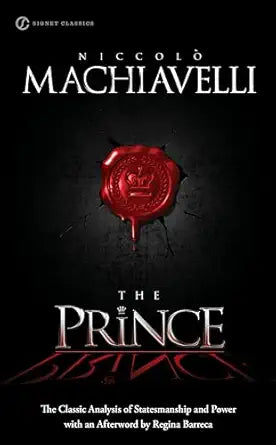
Witty, informative, and devilishly shrewd, The
Prince is Machiavelli's classic analysis of statesmanship and power.
“It is best to be both feared and loved, however, if one cannot be both,
it is better to be feared than loved.”—Machiavelli
For over four hundred years, The Prince has been the basic
handbook of politics, statesmanship, and power. Written by a Florentine
nobleman whose name has become a synonym for crafty plotting, it is a
fascinating political and social document, as pertinent today as when it first
appeared. After a lifetime of winning and losing at the game of politics,
Machiavelli set down for all time its ageless rules and moves, in this highly
readable formula for the man who seeks power. At a time before modern
democracy, Machiavelli was less concerned with right and wrong than with
currying favor with the ruling Medicis, and his work came to be thought of as a
blueprint for dictators.
The Prince has long been required reading for those interested in
politics and power, and it has long since become one of the world's most
significant books.
About the Author
Niccolò Machiavelli (1469-1527) was a Florentine
statesman who was later forced out of public life. He then devoted himself to
studying and writing political philosophy, history, fiction, and drama.
Regina Barecca, Professor of English and Feminist Theory at the
University of Connecticut, is the editor of the influential journal LIT:
Literature, Interpretation, Theory. Among her many books areThey Used to
Call Me Snow White...But I Drifted, a widely acclaimed study of women’s
humor, andBabes in Boyland, It’s Not That I’m Bitter...,
and Untamed and Unabashed: Essays on Women and Humor in British
Literature. She is also the editor of The Penguin Book of Women’s
Humor.